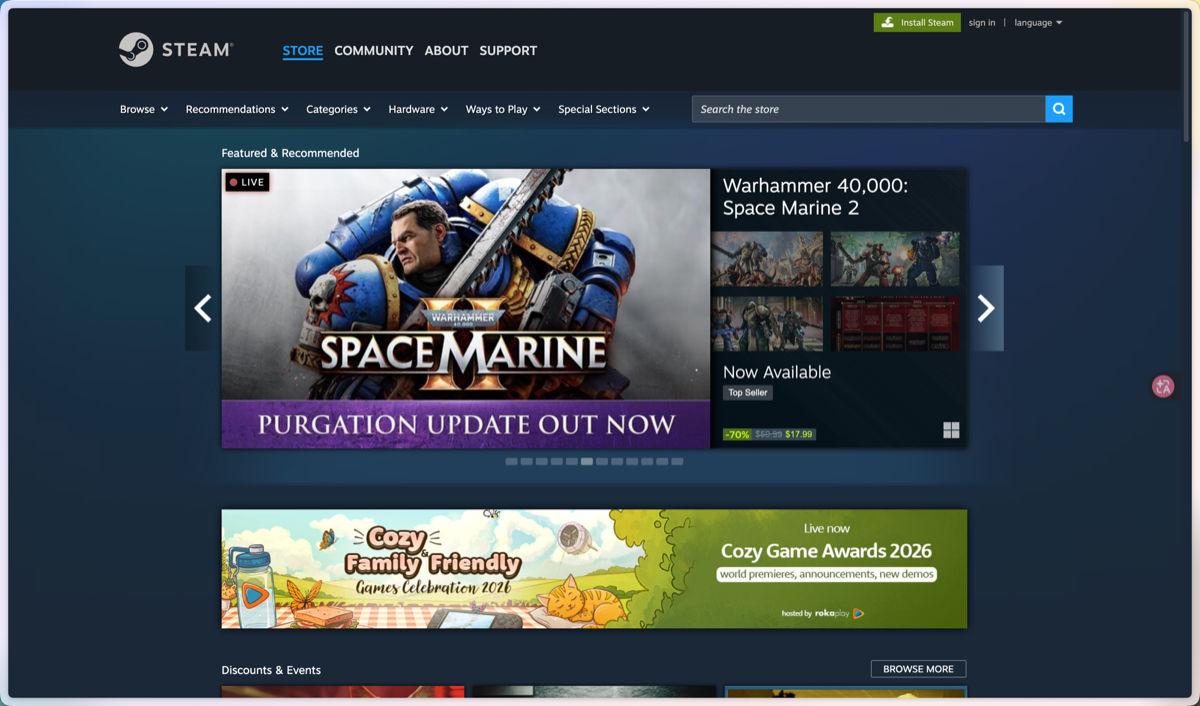
Your Guide to Upcoming Steam Sales and Deals
If you've been around PC gaming for a while, you know the rhythm of the year is marked by one thing: the next big Steam sale. Getting a handle on when these major sales will drop is your best weapon for building an amazing library without breaking the bank.
Mapping Out the 2026 Steam Sale Calendar
Valve doesn't just spring sales on us randomly. While they only give official confirmation a few months out, the major seasonal sales have followed a predictable pattern for years. This consistency is a huge advantage, letting us forecast the sale windows with a pretty high degree of confidence. You can start planning your budget and polishing your wishlist long before the madness begins.
It's not just about the big four seasonal events, either. Steam's calendar is also peppered with themed "Fests" and publisher-specific sales that can offer incredible deals. These are perfect for diving deep into a genre you love or finally grabbing that one elusive indie gem.
The Big Three Seasonal Sales
The events that everyone waits for are the Summer, Autumn, and Winter sales. This is when the floodgates open and you'll see thousands of games, from AAA blockbusters to indie darlings, get their prices slashed by as much as 75-90%.
- Steam Summer Sale (Late June - Early July 2026): This is the main event. It’s a massive, two-week-long blowout and easily the best time of year to clear out a hefty chunk of your wishlist.
- Steam Autumn Sale (Late November 2026): Perfectly timed with the Black Friday and Cyber Monday shopping frenzy, this sale runs for about a week. It also kicks off the nomination process for the annual Steam Awards.
- Steam Winter Sale (Late December 2026 - Early January 2027): Almost as big as its summer counterpart, this sale wraps up the year. It runs through the holidays and coincides with the final voting for the Steam Awards, making it a major finale for gamers.
This timeline gives you a great visual forecast for when to expect these key sales.

Based on years of historical data, we can put together a pretty solid forecast for the year. This helps you decide when to pull the trigger and when to hold off for a better deal.
Estimated 2026 Steam Sale Schedule
| Sale Event | Estimated Start Window | Typical Discount Range | Key Game Categories |
|---|---|---|---|
| Spring Sale | Mid-March 2026 | 25-75% | Recent releases, indie highlights |
| Summer Sale | Late June - Early July 2026 | 50-90% | AAA titles, major franchises, everything |
| Autumn Sale | Late November 2026 | 40-85% | Big publishers, VR games, Steam Deck |
| Winter Sale | Late Dec 2026 - Early Jan 2027 | 50-90% | Games of the Year, back catalog classics |
This schedule isn't just about the dates; it’s about understanding the type of sale. The Summer and Winter events are where you'll see the deepest, broadest discounts, while the Spring and Autumn sales are great for more targeted purchases.
Don't Overlook Themed Fests
Beyond the big seasonal events, keep an eye out for the smaller, genre-focused fests. These happen almost monthly and are a goldmine for niche titles.
Events like "Strategy Fest," "FPS Fest," or "Farming Fest" put a spotlight on specific gameplay styles, often with discounts that are just as good as the major sales—but only for those games. "Next Fest" is another big one, offering hundreds of demos for upcoming titles. If you want to get a better sense of how these events are timed, you can find helpful patterns in our guide that looks at how long the Steam Summer Sale typically lasts.
The real secret to mastering Steam sales isn’t just memorizing the dates. It's about learning the rhythm of the entire year. By tracking both the major sales and the smaller themed fests, you can build a smart purchasing strategy that guarantees you never have to pay full price for a game on your wishlist again.
Forget New Releases—Here's Where the Real Steam Sale Deals Are

When the next upcoming steam sales event kicks off, your eyes will naturally drift to the latest blockbusters, flashing a modest 10-15% discount. It's tempting, I get it. But let me tell you, after years of navigating these sales, the real value isn't in the new stuff. It’s in the classics.
Chasing that tiny discount on a brand-new game is a rookie mistake. The truly smart play is to look at games that have been out for a year or two. Not only will the discounts be significantly steeper, but you're also getting a much more polished product. All the launch-day bugs have been squashed, and you can often snag a "Game of the Year" edition—with all the DLC included—for less than the original base game cost.
The Numbers Don't Lie: Follow the Money (and the Playtime)
It’s easy to get swept up in the hype of new releases, but the data on Steam tells a completely different story. While shiny new titles grab the headlines, it’s the tried-and-true back catalog that actually drives player engagement and, frankly, keeps Valve’s lights on during a big sale.
The stats are pretty staggering. In 2025, Valve's total revenue reportedly hit $16 billion, but games released that same year only contributed $5.5 billion to that total. This means over 65% of Steam's earnings came from older titles. Think about that—nearly 20,000 new games were released, yet the vast majority of them faded into obscurity, earning a median revenue of just $317 and seeing an average playtime of a mere 5.6 hours. You can dig into the specifics in this detailed report about Steam's 2025 performance.
What this really means for you is that the best deals are always going to be on these proven hits. A jaw-dropping 86% of total user playtime in 2025 was spent on games released in previous years. These are the games people keep coming back to, and they're the ones that will get the deepest discounts.
This isn’t just about being frugal; it’s about making a smarter investment in your entertainment. An older, critically acclaimed game with hundreds of hours of content for a few bucks is simply a safer bet than a full-priced new release with a "Mixed" review score.
Turn Your Wishlist into a Strategic Tool
Alright, so you're sold on the idea of hunting for older gems. How do you apply this to your own wishlist? This is where you can get a little analytical and stop buying games you'll never play. Tools exist that can help you understand your own gaming DNA.
One of the most useful I've found is the Steam Calculator. It’s a simple tool that connects to your Steam profile and gives you a fascinating breakdown of your habits. It’s like a financial audit for your game library.
Here's what it can show you that's actually useful:
- Cost-Per-Hour: This is the gold standard metric. It breaks down exactly which games gave you the most playtime for what you paid. You’ll quickly see that the indie gem you bought for $5 gave you more value than the AAA title you pre-ordered.
- Genre Hoarding: The calculator might reveal you own 30 RPGs but have only played five of them. That's a clear signal to stop buying more, no matter how cheap they are.
- Your "Actually Finished" List: See which types of games you consistently see through to the credits. This helps you identify what you truly enjoy, not just what you think you should be playing.
By arming yourself with this kind of data, you can stop the impulse buys and start building a library you'll actually use. You'll shift your focus from chasing novelty to acquiring high-quality experiences that fit your real play style. In any upcoming steam sales event, the best deals aren’t just cheap—they’re the ones that have already stood the test of time.
Your Wishlist Is Your Secret Weapon
Most people treat their Steam Wishlist like a passive "someday" pile. You add a game, forget about it, and maybe buy it when Steam sends a generic sale email. That’s leaving a ton of money on the table.
To really master a Steam sale, you need to transform your wishlist from a simple shopping list into a strategic command center. This means going beyond Steam's basic notifications and getting a little smarter about how you track deals.
After all, the standard email alert only tells you a game is on sale—it doesn't tell you if it's a good sale. Is that 50% discount a true bargain, or was the same game 75% off just a few months ago?
Know the Price History Before You Pull the Trigger
This is where you gain a real edge. By using a price tracker, you can see every past sale for a specific game, giving you the context to know if a deal is actually worth it.
For instance, say a game you've been eyeing drops from $59.99 to $29.99. That feels like a solid 50% off, right? But what if a quick look at its price history shows it hit $19.99 during the last Winter Sale? Suddenly, that deal doesn't seem so hot. Now you can confidently wait, knowing a better price is almost certainly on the horizon.
This is exactly the kind of pattern you can spot with a tool like Steam Calculator. The historical price chart lays it all out for you.
See those sharp dips in the graph? They almost always line up with major seasonal sales. This data lets you make a calculated decision instead of just reacting to the first discount that pops up.
The goal is to turn your wishlist from a passive collection of games into an active "buy-at-this-price" list. By knowing the historical lows, you can set your own targets and only spend when the deal is genuinely great.
Curate Your Wishlist for Maximum Impact
A bloated wishlist with hundreds of games is your enemy. It just creates notification fatigue and encourages you to make impulse buys you'll regret later. Before any big sale, it's time to do some house cleaning.
Get ruthless and ask yourself a few tough questions about every game on your list:
- The "Right Now" Test: If this game went on sale for 90% off today, would you actually stop what you're playing and install it immediately? If not, it's not a priority.
- The Genre Check: Take a look at your recently played games. If you've been mainlining strategy titles for months, maybe prioritize that new 4X game over the open-world RPG you added two years ago.
- The One-Year Rule: Has a game been sitting on your list for more than a year, surviving multiple sales? It might be time to admit you're just not that into it and cut it loose.
By regularly pruning your list, you ensure that every sale notification you get is for a game you're genuinely excited to play. This focused approach is key. If you want to dig deeper into this strategy, our guide on how a Steam game price tracker can save you money breaks it down even further. It's the best way to turn your wishlist into a powerful tool for any upcoming Steam sales.
How to Budget and Prioritize Before a Sale
 Walking into a Steam sale without a plan is a dangerous game. It's the fastest way to end up with a cart full of impulse buys and a feeling of regret. To come out on top, you need to do your homework, starting with a solid budget and a clear-headed list of priorities.
First thing's first: set a hard spending limit before the sale even starts. Be honest with yourself. Whether it’s $20 or $100, locking in that number is your best defense against the siren song of a 75% discount on a game you'll never play.
Think of it as your war chest. Once it's empty, you're done until the next big sale. This simple rule forces you to be deliberate and focus only on the games you’re truly excited about.
Analyze Your Gaming DNA
To spend wisely, you need to know thyself. And I don't mean the gamer you think you are—I mean the one your play history proves you are. This is where a little data goes a long way.
Fire up a tool like Steam Calculator. By analyzing your profile, it can show you some surprising truths about where your time and money have really gone. You might discover that even though you own a dozen RPGs, you spend 90% of your gaming hours in strategy titles.
That kind of insight is pure gold. It helps you build a priority list that matches your actual habits, so your sale purchases don't just become another layer in your digital "pile of shame."
The goal isn’t just to buy cheap games; it’s to buy the right games for you. Using your own play data to guide your choices is the single best way to maximize the value you get from any upcoming steam sales event.
Prioritize Purchases with Smarter Metrics
With a budget in hand and a better understanding of your play style, it's time to get tactical with your wishlist. A simple, unranked list of "wants" just won't cut it. You need to dig deeper.
Look past the price tag and start thinking about metrics that reflect a game's real value to you. This is how you transform a sprawling wishlist into a surgical strike plan.
- Cost-Per-Hour: This is the ultimate value calculation. A $30 game you'll sink 100 hours into is just $0.30/hour. That’s a far better deal than a $10 game you finish in five hours at $2/hour. Look up a game's average playtime and do the quick math.
- Completion Rate: Be brutally honest with yourself. How many of those sprawling open-world games in your library have you actually finished? If the answer is "not many," a new one should probably be at the bottom of your list, no matter how cheap it is.
- Immediate Play Factor: Is this a game you'll install and fire up the moment you buy it? If you know it’s just going to sit in your library for six months, it's not a priority.
This data-driven mindset shifts your focus from "How much does it cost?" to "How much will I actually enjoy it?" We see this play out on a massive scale, too. Steam's Best of 2025 data revealed that 44% of playtime happened on games over five years old. Discounts are a huge reason why, pushing evergreen titles like PEAK to over 16 million lifetime sales. You can dive into how sales shape Steam's top earners on GameDiscoverCo's newsletter. By using tools like the Steam Calculator tracker, you're essentially applying the same value-driven logic to your own library.
Smart Buying Tactics When the Sale Goes Live
The moment the upcoming steam sales event drops, the storefront becomes a sensory overload of flashing discounts and "limited-time" offers. It’s an exciting, chaotic rush, but it’s also engineered to make you spend on impulse. The key is to take a breath, trust the plan you already made, and buy with your head, not just your hype.
The biggest mistake you can make is rushing in on day one. I've seen it time and time again. That feeling of urgency is a sales tactic, but a game’s discount is almost always locked in for the entire event. There's no real benefit to buying immediately, and you might even miss a rare flash deal. The seasoned shoppers I know add their top picks to the cart and then simply wait until the final 24-48 hours before pulling the trigger.
Trust Your Prep, but Verify with Live Data
Alright, you’ve got your budget set and your priority list ready. Now it's time to see how your plan holds up against reality. Open up that Steam wishlist and see which of your most-wanted games hit the price you were hoping for—that magic number you found by checking their sale history. If a "Tier 1" game on your list just hit an all-time low, that’s your green light.
This is also where your Steam Calculator profile becomes a powerful reality check. Before you add another massive open-world RPG to your cart, take a quick look at your genre breakdown. Seeing that you already have five of them sitting unplayed is a stark reminder to stick to your guns. Watching how a new purchase impacts your library's value and your cost-per-hour stats can be the final nudge you need to make a smart choice instead of an emotional one.
The sheer scale of these sales is mind-boggling. December 2025, for instance, became Steam's biggest month ever, pulling in $1.6 billion in revenue, largely thanks to massive discounts. A game like Detroit: Become Human moved almost a million units priced at just $4 a pop. These numbers show just how much money is flying around and why having a tool with a real-time tracker is essential to cut through the noise.
Digging for Deeper Discounts and Dodging Duds
Beyond the individual price tags, always hunt for hidden value in bundles. Publisher collections or "Complete the Set" deals can often shave an extra 10-25% off the already-discounted prices. Best of all, if you already own a game in the set, Steam automatically adjusts the bundle price so you’re only paying for the titles you’re missing.
A steep discount doesn't always mean a good deal. Before finalizing your cart, do a quick quality check by looking at the "Recent Reviews" on the store page. A massive price drop on a game with "Mostly Negative" recent feedback is a huge red flag that it might be a buggy, abandoned mess.
Finally, remember that patience is your ultimate trump card. If a game you really want didn't get the deep discount you were hoping for this time, just let it go. You can learn more about these patterns in our guide to Steam sale price history. Another huge sale is never more than a few months away.
Common Questions About Steam Sales Answered

Even with the best-laid plans, a few nagging questions always seem to pop up once the upcoming steam sales kick off. Let's run through some of the most common ones I hear from other gamers so you can go into the next event with complete confidence.
Think of this as the final checklist before you dive in. Getting these details straight helps you stick to your strategy and avoid those classic sale-time mistakes.
How Reliable Are Steam Sale Date Predictions?
For the four major seasonal sales, they're incredibly reliable. These forecasts are built on more than a decade of data, and the patterns are so consistent you can practically set your watch by them. This lets you map out a gaming budget months ahead of time.
Valve usually drops the official dates a few months out, but the community predictions are almost always spot-on. The smaller, themed fests can be a little more spontaneous, but even they tend to follow a predictable yearly rhythm. You're rarely ever caught completely by surprise.
Should I Buy a Game on Day One of a Sale?
My advice? Almost always wait. A game's discount is set for the entire duration of the sale. The smartest play is to load up your cart with everything you're interested in and only click "purchase" in the last 24-48 hours of the event.
The only reason to buy on day one is if you absolutely have to play the game that minute. Otherwise, waiting protects you from impulse buys and the buyer's remorse that often follows. It also saves you the hassle of refunds if a rare, deeper discount does pop up.
A key takeaway for any sale veteran is this: The deals aren't going anywhere. The initial rush is designed to create a sense of urgency, but smart shoppers know that the best price on day one is usually the same price on the last day.
How Should I Use Steam Calculator During a Sale?
I use it in two distinct phases. First, before the sale even starts, I use its wishlist tracker to look at the price history for games I'm eyeing. This tells me if a "deal" is actually an all-time low or just the same discount it gets every other month.
Then, during the sale, I use it as a reality check. I'll analyze my profile and look at the updated cost-per-hour and genre stats. Seeing that I already have five unplayed open-world RPGs helps me logically kill an impulse to buy a sixth. It turns an emotional decision into one based on my actual gaming habits.
Can I Get a Refund if a Price Drops Further?
Yes, you can. Steam's refund policy is your safety net. As long as you've played a game for less than two hours and owned it for less than 14 days, you can request a full refund, no questions asked.
You can then just buy the game again at the new, lower price. While this is a great feature, it's honestly just simpler to wait until the end of the sale to make your purchases in the first place.
Total up your wishlist, track potential sale spend, and decide when to buy.